


Can you wash a duvet in a washing machine? Often, yes —
but only if the duvet’s care label permits machine washing and your washing
machine has enough space for the duvet to move freely during the cycle.
A lightweight synthetic duvet may be straightforward to wash at home.
A thick double, king-size or natural-filled duvet needs more consideration
because filling type, machine capacity and drying requirements can change
the safest cleaning method.
Check the care label first. If machine washing is allowed, the duvet should
fit comfortably in the drum without being tightly compressed. If it fills
the machine too tightly, has a delicate filling, or cannot be dried
thoroughly afterwards, professional cleaning or a larger-capacity machine
may be safer.
Can You Wash a Duvet in a Washing Machine?
The answer depends on three things: the care label, the duvet filling and
the size of your washing machine.
A duvet should never be washed simply because it can physically be pushed
through the washing-machine door. It needs enough room inside the drum for
water, detergent and movement to reach the filling properly.
Is Your Washing Machine Big Enough for a Duvet?
Machine capacity is one of the most important practical checks before
washing a duvet at home.
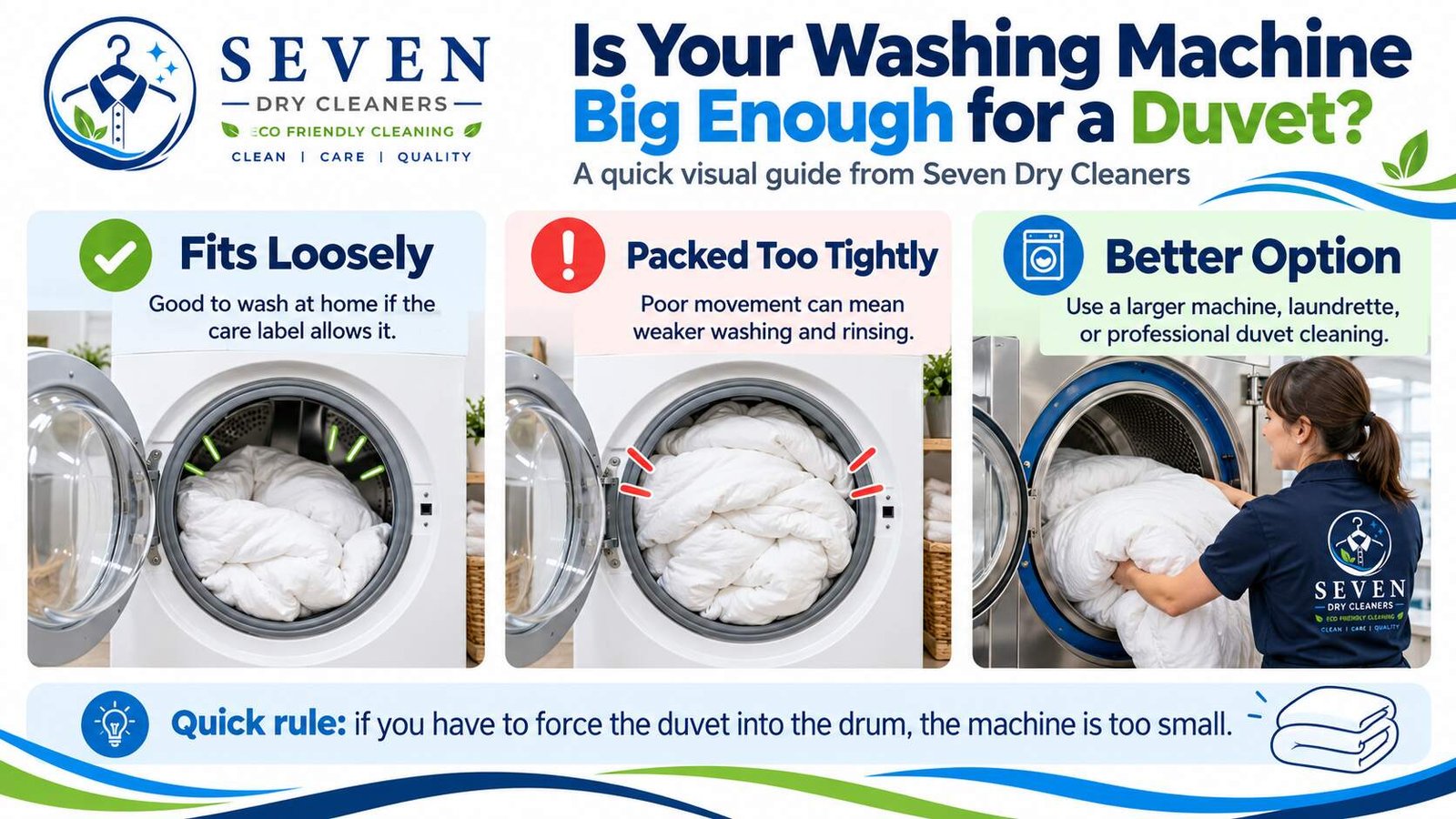
Do Not Force the Duvet into the Drum
Place the dry duvet into the empty washing machine without pushing or
compressing it down.
If you need to squash it tightly just to close the door, the machine is
too small for that duvet.
Why Drum Space Matters
If a duvet is packed too tightly, water and detergent may not circulate
evenly through the filling. Rinsing can also be less effective, leaving
detergent or moisture trapped inside.
A single lightweight duvet may fit comfortably in many domestic machines,
while thicker double, king-size and super-king duvets often need a larger
capacity washer.
The kilogram rating is only a guide because duvet thickness and filling
density also affect how much space the item needs.
Synthetic, Feather, Down, Wool or Silk? The Filling Matters
Not every duvet reacts to water, heat and mechanical action in the same way.
The care label should always take priority over a general rule about filling
type.
| Filling | General Considerations |
|---|---|
| Synthetic / Hollowfibre | Many synthetic duvets are machine washable, but check the care label and machine capacity first. |
| Feather & Down | Some feather and down duvets can be machine washed on a delicate cycle, while others have different care instructions. |
| Wool | Some wool products are machine washable when the care label allows it, but others require more delicate treatment. |
| Silk or Specialist Fillings | These may have more restrictive care requirements, so follow the label and consider specialist cleaning where appropriate. |
Synthetic Duvets
Synthetic duvets are often the easiest type to wash at home, provided the
care label permits machine washing and the drum has enough capacity.
Do not assume every synthetic duvet is identical. Construction, outer
fabric and manufacturer instructions can still differ.
Feather and Down Duvets
Some feather and down duvets are suitable for machine washing. M&S
advises that washable feather and down duvets may be cleaned at around
30-40°C on a delicate cycle with a small amount of mild detergent, while
avoiding fabric softener.
The care label on your actual duvet should always take precedence.
Wool Duvets
Wool needs care because not every wool item should be washed in the same
way. Woolmark states that wool products can be machine washed when their
care claim specifically allows it and recommends using the appropriate wool
or delicate cycle.
If the duvet label does not allow machine washing, do not assume a low
temperature alone makes it safe.
Silk and Specialist Fillings
Silk and other specialist fillings may require delicate treatment. If the
care label is unclear, missing or specifically calls for professional care,
avoid experimenting with a domestic wash.
How to Wash a Duvet in a Washing Machine
If the care label confirms that machine washing is permitted and the duvet
fits comfortably in the drum, use a careful process.
1. Wash the Duvet on Its Own
Do not add towels, sheets or clothing to the same wash. The duvet needs the
available drum space for water and detergent to circulate properly.
2. Check for Stains Before Washing
Inspect the duvet for localised food, drink or other stains. Avoid aggressive
rubbing or unsuitable household chemicals, especially on delicate outer
fabrics.
A persistent or unusual stain may be better professionally assessed.
3. Follow the Care-Label Temperature
Do not automatically choose the hottest cycle. The care label gives the
maximum permitted treatment for that particular textile item.
GINETEX notes that lower temperatures and milder treatment than the maximum
shown on the label are permitted where appropriate.
4. Use the Appropriate Cycle
A bulky duvet can place significant mechanical load on a machine, so use the
cycle stated on the label. Where a gentle or delicate process is required,
do not substitute a heavy everyday wash.
5. Use Detergent Carefully
Using more detergent does not necessarily result in a cleaner duvet. A bulky
filling can be harder to rinse thoroughly, so excessive detergent may remain
inside the item.
Follow the detergent manufacturer’s guidance and the duvet manufacturer’s
care instructions.
6. Consider an Extra Rinse
If the machine allows it and the duvet still feels soapy after the wash, an
additional rinse may help remove residual detergent.
Drying a Duvet Is Just as Important as Washing It
One of the biggest risks with washing a duvet at home is inadequate drying.
The outside may feel dry while moisture remains trapped deeper inside the
filling.
M&S warns that duvets should be dried quickly and thoroughly because
lingering dampness can contribute to mould and musty odours.

If Tumble Drying Is Allowed
Follow the drying temperature shown on the care label.
For suitable feather and down duvets, low heat and dryer balls can help
separate the filling and reduce clumping.
If You Are Air Drying
Spread the duvet over as much surface area as possible in a well-ventilated
space rather than leaving it folded.
Turn and shake it periodically so trapped moisture can escape from different
areas and the filling can redistribute.
Before Putting It Back on the Bed, Check For:
- cool or damp areas
- unusually heavy sections
- clumped or uneven filling
- musty or damp odours
If any of these are present, the duvet needs more drying time.
When You Should Not Wash a Duvet at Home
Some duvets are not good candidates for domestic washing, even if fitting
them into the machine appears possible.
- The care label requires professional cleaning.
- The filling type is unknown and the care label is missing.
- The duvet is too large to move freely inside the washing machine.
- The duvet cannot be dried thoroughly afterwards.
- It contains delicate silk, wool or specialist materials with restrictive care instructions.
- The duvet has significant stains, damage or unusual construction.
- It is expensive, handmade or otherwise difficult to replace.
If the duvet is washable but simply too large for your domestic washer,
a larger-capacity launderette machine may solve the problem.
If the fabric, filling, stain or construction is the concern, a bigger
washing machine does not remove that risk.
Can You Wash a King-Size Duvet in a Washing Machine?
Possibly, but not every domestic washing machine has enough usable drum
space for a king-size duvet.
The important question is not simply whether the door closes. The duvet
must fit loosely enough to move during washing.
A thick king-size duvet may require a commercial or high-capacity washer
even if a thinner king-size duvet would fit into the same domestic machine.
Can You Wash a Duvet Without a Care Label?
This is more difficult because you do not have the manufacturer’s guidance
on wash temperature, drying method or permitted professional treatments.
If you know the filling and construction with confidence, you may be able
to obtain manufacturer guidance elsewhere. If not, professional assessment
is the safer option, particularly for natural or delicate fillings.
How Seven Dry Cleaners Approaches Duvet Care
Seven Dry Cleaners is based on Northfield Avenue in Ealing, West London.
When a duvet is brought in for professional care, the item should be
considered based on its care instructions, size, filling, visible stains
and overall condition rather than treated using one blanket rule.
The care label helps identify whether washing, drying or professional
cleaning treatments are permitted.
A thick natural-filled duvet may require a different approach from a
lightweight synthetic duvet.
Cleaning and stain-removal results depend on the duvet’s fabric, filling,
condition and previous treatment.
Professional Duvet Cleaning in London
If your duvet is too large for your home washing machine, has specialist
care instructions, contains delicate materials or has stains that need
professional assessment, Seven Dry Cleaners provides professional garment
and household textile cleaning from its Ealing location.
You can explore our
dry cleaning and laundry services in London
or contact the team if you are unsure which cleaning method is suitable.
Need Help With Your Duvet?
Tell us the duvet size, filling type, care instructions and any stains or
concerns so the item can be assessed more accurately.
Frequently Asked Questions
Can you wash a duvet in a washing machine?
Yes, if the care label allows machine washing and the duvet fits comfortably
in the drum with enough space to move during the cycle. If it is tightly
compressed, the machine is too small.
Can you wash a king-size duvet in a normal washing machine?
It depends on the washing machine’s usable drum capacity and the thickness
of the duvet. Many king-size duvets need a larger-capacity washer because
they cannot move freely in an ordinary domestic machine.
Can you wash a feather duvet in the washing machine?
Some feather and down duvets are machine washable, but the individual care
label should be followed. Washable feather and down products commonly
require a delicate cycle, mild detergent and thorough low-temperature drying.
Can you wash a wool duvet in a washing machine?
Only when the care label specifically permits machine washing. Woolmark
advises using an appropriate wool or delicate cycle for wool products whose
care claim allows machine washing.
How do you know when a duvet is completely dry?
Check for cool or damp areas, heavy sections, clumped filling and musty
odours. If any are present, continue drying before storing or using the duvet.
What if my duvet is too large for my washing machine?
If the duvet is otherwise machine washable, a large-capacity launderette
machine may be suitable. If the material, filling, stain or care instructions
are the concern, professional cleaning may be more appropriate.
The Bottom Line
Can you wash a duvet in a washing machine? Often yes,
provided the care label permits it, the duvet has enough room to move inside
the drum and you can dry it completely afterwards.
Synthetic duvets are often straightforward, while feather, down, wool, silk
and specialist fillings need closer attention to their individual care
instructions.
If the duvet is too large, delicate, heavily stained or difficult to dry,
professional assessment may be a better option than forcing it through a
domestic washing cycle.


2 thoughts on “Can You Wash a Duvet in a Washing Machine?”