

Eco wet cleaning is a professional, water-based method
used to clean suitable garments that may otherwise be associated with
traditional dry cleaning. It combines controlled washing, specialist
detergents, careful drying and professional finishing rather than simply
putting delicate clothes through an ordinary washing-machine cycle.
The word wet can make the process sound like normal laundry, but
professional wet cleaning is different. The cleaner controls factors such
as mechanical action, temperature, water level, detergent dosing, drying
and finishing according to the garment and its care requirements.
Eco wet cleaning uses water as the main cleaning medium instead of relying
on a traditional dry-cleaning solvent. It can be an environmentally
preferable option for many suitable garments, but it is not automatically
appropriate for every fabric, construction or care label. A professional
assessment still matters.
What Is Eco Wet Cleaning?
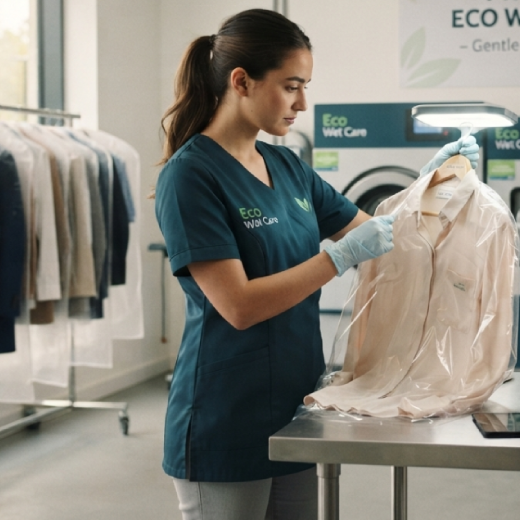
Eco wet cleaning, also known as professional wet cleaning, is a specialised
garment-care process that uses water together with professional equipment,
controlled programmes and detergents designed for textile care.
Its purpose is not to reproduce a normal household wash. Professional wet
cleaning gives the cleaner much greater control over how much movement,
moisture, heat and drying a garment experiences.
The U.S. Environmental Protection Agency has also described professional
wet cleaning as a water-based system using specialised machines that can be
programmed for variables such as mechanical action, water temperature,
drying temperature, moisture levels and detergent quantities.

How Does Professional Eco Wet Cleaning Work?
The exact process varies according to the garment, equipment and professional
system being used, but a typical workflow includes assessment, stain
treatment, controlled wet cleaning, drying and finishing.
1
Garment Assessment
The care label, fabric, colour, construction, trims, lining and visible
stains are considered before deciding whether wet cleaning is appropriate.
2
Stain Assessment
Visible marks can be assessed before cleaning. Different stains react
differently to water, detergent and professional stain-treatment products.
3
Controlled Cleaning
The machine programme controls factors such as water level, temperature,
mechanical action and cycle intensity to reduce unnecessary stress on the
garment.
4
Drying & Finishing
Drying is controlled and the garment may then require professional
reshaping, pressing or finishing before it is ready for collection.
Eco Wet Cleaning Is Not the Same as Washing Clothes at Home
This is one of the most important distinctions and one that many short
explanations of wet cleaning miss.
A domestic washing machine is designed primarily for ordinary washable
laundry. It does not give a professional cleaner the same combination of
programme control, textile-specific detergents, controlled drying,
finishing equipment and garment-care judgement.
That means a jacket that may be suitable for professional wet cleaning
should not automatically be placed in a domestic washer.
“Wet cleanable” and “machine washable at home” do not mean the same thing.
Always follow the garment’s care instructions and do not treat a
professional wet-cleaning recommendation as permission for ordinary
domestic washing.
What Does the Wet Cleaning Symbol Mean?
Textile care labels can include a professional wet-cleaning symbol. In the
GINETEX system, professional textile care is represented by a circle, with
specific wet-cleaning markings used to indicate normal, mild or very mild
professional wet cleaning.
A crossed-out professional wet-cleaning symbol means that professional wet
cleaning is not permitted for that article.
The bars beneath a professional-care symbol matter because they indicate
that reduced mechanical action or other limitations may be required.
Eco Wet Cleaning vs Dry Cleaning
Wet cleaning and dry cleaning are both professional garment-care methods,
but their main cleaning media are different.
| Feature | Professional Eco Wet Cleaning | Professional Dry Cleaning |
|---|---|---|
| Main cleaning medium | Water with professional detergents and controlled programmes | Professional cleaning solvent rather than water as the main cleaning medium |
| Equipment | Specialised programmable washer, dryer and finishing equipment | Professional dry-cleaning machine plus spotting and finishing equipment |
| Home washing equivalent? | No | No |
| Suitable for every garment? | No | No |
| Care-label assessment needed? | Yes | Yes |
| Environmental distinction | Water-based process that can reduce reliance on solvent-based cleaning for suitable garments | Uses professional solvents; environmental profile depends on the solvent and system used |
It is therefore misleading to treat the choice as simply “wet cleaning is
good, dry cleaning is bad.” The correct professional treatment should be
selected according to the garment, its care instructions, construction,
staining and condition.
Why Is Wet Cleaning Considered More Eco-Friendly?
The environmental case for professional wet cleaning is mainly that it can
clean suitable garments using a water-based process rather than relying on
a conventional solvent-based dry-cleaning method.
The EPA has examined professional wet cleaning as an alternative to
perchloroethylene-based dry cleaning, and research listed by the agency has
evaluated wet cleaning as a pollution-prevention option.
That does not mean wet cleaning has zero environmental impact. It still
uses water, energy and detergents, and drying and finishing require energy.
A credible environmental claim should acknowledge those inputs rather than
describe the process as completely impact-free.
What “Eco-Friendly” Should Not Mean
Be cautious with claims such as “chemical-free”. Water, detergents and
professional stain-treatment products are all substances used within
cleaning processes.
A more accurate description is that professional wet cleaning is
water-based and can reduce the need for traditional
solvent-based cleaning for garments that are suitable for the process.
Which Garments May Be Suitable for Professional Wet Cleaning?
Suitability depends on more than the fibre name printed on a label. Fabric,
dye stability, linings, interlinings, trims, adhesives, decorative details
and garment construction can all affect treatment.
Depending on the individual garment and care instructions, professional wet
cleaning may be considered for selected:
- wool and wool-blend garments
- delicate dresses and blouses
- selected jackets and tailored garments
- viscose and other sensitive fabrics
- selected silk garments
- coats and outerwear
- other garments labelled for professional wet cleaning
This list is not a guarantee that every garment in those categories can be
wet cleaned.
For example, two wool jackets may contain different linings, shoulder
structures, dyes or trims and may therefore require different treatment.
Can Wool Be Professionally Wet Cleaned?
Some wool garments can be treated using suitable professional wet-cleaning
systems, but the garment’s care information and construction should be
checked first.
The Woolmark Company has licensed a specific professional wet-cleaning
system for approved use with certain wool products. That is evidence that
professional water-based care can be appropriate for selected wool
garments, but it should not be interpreted as permission to wet clean every
wool item or to wash it at home.
When Might Wet Cleaning Not Be the Best Choice?
A genuinely useful guide should explain the limits as well as the benefits.
Professional wet cleaning is not automatically the right process for every
garment.
A cleaner may decide that another professional treatment is more
appropriate when there are concerns about:
- water-sensitive dyes or finishes
- complex tailoring or structured components
- certain adhesives or bonded constructions
- fragile embellishments and trims
- garment condition or age
- care instructions that prohibit professional wet cleaning
- stains that respond better to another professional process
The important point is not to force a garment into a method simply because
the method has an environmental advantage.
Does Wet Cleaning Remove Every Type of Stain?
No professional cleaning process can guarantee removal of every stain.
Results depend on the stain itself, how long it has been present, the
fabric, previous home treatment and the garment’s overall condition.
Water-based stains and oily stains behave differently, which is one reason
professional cleaners assess and pre-treat marks rather than relying on the
main cleaning cycle alone.
Aggressive stain removal can sometimes create more risk than leaving a
faint mark, particularly on delicate or colour-sensitive fabrics.
Does Professional Wet Cleaning Cause Shrinkage?
Poorly controlled exposure to water, heat or mechanical action can affect
some textiles. Professional wet cleaning is designed to manage those risks
through controlled programmes and professional finishing.
However, no responsible cleaner should claim that every garment can be wet
cleaned without risk. Care instructions, textile behaviour and construction
still need to be considered.
Why Finishing Matters After Wet Cleaning
Cleaning is only part of the professional process.
After water-based cleaning, garments may require careful drying, reshaping,
steam finishing or pressing to restore their intended appearance.
This finishing stage is another reason professional wet cleaning should not
be confused with putting a delicate garment into a household washing
machine and hanging it to dry.
How to Choose an Eco-Friendly Cleaner Without Falling for Greenwashing
The phrase “eco-friendly dry cleaning” can describe very different
processes. Rather than relying on the wording alone, ask practical
questions.
Ask What Cleaning Method Is Actually Used
A professional cleaner should be able to explain whether a garment is being
wet cleaned, dry cleaned or treated using another method.
Ask Whether Every Garment Is Treated the Same Way
A one-method-fits-all claim should be treated cautiously. Responsible
garment care involves assessing the actual item.
Ask How the Care Label Is Used
Care instructions are an important part of deciding what treatment is
permitted and how mild the process may need to be.
Be Cautious with Absolute Claims
Phrases such as “chemical-free”, “works on every fabric” or “guaranteed
stain removal” are not useful substitutes for explaining the actual
cleaning process.
How Seven Dry Cleaners Approaches Eco Wet Cleaning
Seven Dry Cleaners is based on Northfield Avenue in Ealing, West London.
Our approach is to consider the actual garment rather than assuming that
every item should receive the same cleaning process.
We consider available care instructions together with fabric, construction
and garment condition.
Visible stains, trims, linings, decorative details and structural elements
can influence the appropriate treatment.
We do not claim that every garment is suitable for wet cleaning or that
every stain can be completely removed.
Eco Wet Cleaning in London
Seven Dry Cleaners provides professional
wet cleaning in London
from our Ealing location for suitable garments.
If you are unsure whether a particular garment is suitable for wet cleaning,
bring it to our shop so the care information, construction and condition can
be considered before treatment.
You can also explore our wider
dry cleaning and laundry services in London
.
Frequently Asked Questions About Eco Wet Cleaning
What is eco wet cleaning?
Eco wet cleaning is a professional water-based garment-care process using
specialised equipment, controlled programmes, detergents and professional
finishing. It is different from ordinary domestic washing.
Is wet cleaning the same as washing clothes in a washing machine?
No. Professional wet cleaning uses specialised equipment and carefully
controlled mechanical action, temperature, drying and finishing. A garment
that can be professionally wet cleaned should not automatically be washed
in a household machine.
Is wet cleaning more eco-friendly than dry cleaning?
Wet cleaning is water-based and can reduce reliance on traditional
solvent-based dry-cleaning processes for suitable garments. It still uses
water, energy and detergents, so it should not be described as having zero
environmental impact.
Can dry-clean-only clothes be wet cleaned?
Some garments commonly associated with dry cleaning may be suitable for
professional wet cleaning, but this depends on the care instructions,
fabric, construction and condition. A professional assessment is required.
Can wool be wet cleaned?
Some wool garments may be suitable for professional wet cleaning when their
care information and construction allow it. This does not mean every wool
garment can be wet cleaned or washed at home.
Does eco wet cleaning use chemicals?
Professional wet cleaning uses water together with detergents and may use
professional stain-treatment products. “Chemical-free” is therefore not an
accurate description. The important distinction is that wet cleaning is a
water-based professional process rather than a traditional solvent-based
cleaning process.
Does wet cleaning remove every stain?
No. Stain-removal results depend on the stain type, fabric, age of the mark,
previous treatment and garment condition. No professional method can safely
guarantee removal of every stain.
Where can I get eco wet cleaning in London?
Seven Dry Cleaners provides professional wet cleaning for suitable garments
from its Northfield Avenue location in Ealing, West London.
Related Garment Care Guides
Not Sure Whether Your Garment Is Suitable for Wet Cleaning?
Bring the garment to Seven Dry Cleaners in Ealing or contact us with details
about the item, its care label and any stains or concerns.
Sources & Further Reading
GINETEX:
Professional textile-care and wet-cleaning symbols
U.S. Environmental Protection Agency:
Professional fabric-care technologies and wet-cleaning information
The Woolmark Company:
Wool garment care and care-label guidance


One thought on “Eco Wet Cleaning: What It Is, How It Works & When It Makes Sense”